WordPress vs Webflow vs AI-Assisted Websites: What Actually Fits a Growing Business
Built on all three. Here's the honest take on which website approach actually fits a growing business - and why ownership and integrations matter more than the platform's marketing.
 Bohdan Meklesh15 Jul 2026· 5 min read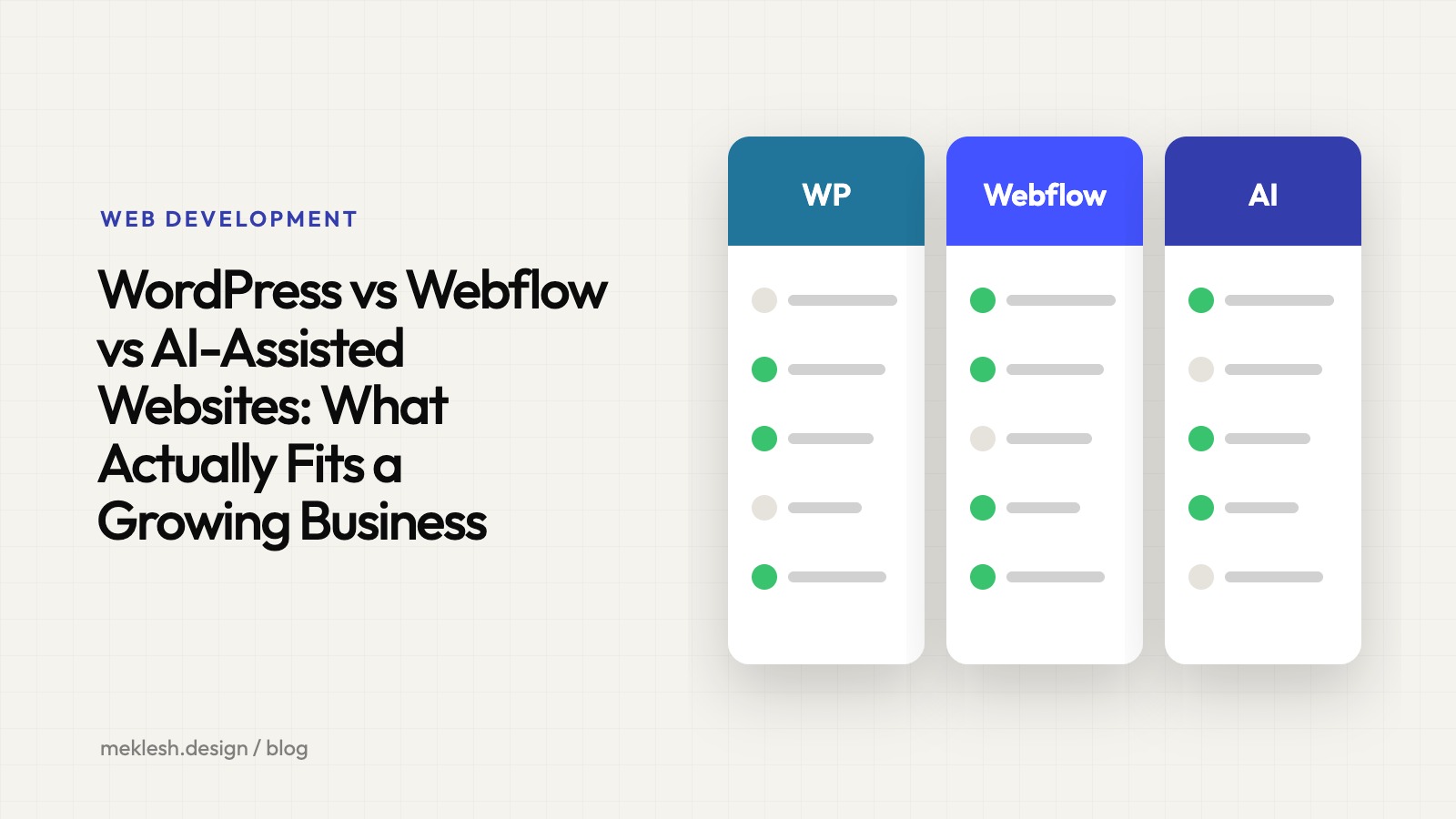
I've built sites on all three. Here's the honest version - not the trendy one.
Most "which platform" articles are written by the platforms themselves. This one isn't. I'm a designer who ships real client sites on WordPress, Webflow, and - more and more - as custom, AI-assisted builds. So instead of "which is most popular," let's ask the question that actually matters for your business: which one lets you move fast, own your stuff, and plug into the tools you already run on?
Start with the real question: does your site fit your business?
Your website isn't a standalone thing. It sits in the middle of your business - your CRM, your email marketing, your booking tool, your analytics. If the site can't talk to those cleanly, you end up with duct tape, Zapier bills, and a lot of "sorry, we can't do that on this plan."
This is where the three approaches really split.
WordPress integrates with almost anything - but usually through plugins. Every integration is another plugin: another thing to update, another possible conflict, another security hole. It works, but the stack gets heavy fast.
Webflow looks clean and is genuinely great for design. Integrations are its weak spot, though - you're mostly limited to embeds, native connections, or third-party middleware, and anything custom means workarounds. Want a tailored HubSpot flow or a Monday.com sync? You'll be fighting the platform.
AI-assisted custom sites - what I build now: modern code, shipped fast with AI tooling but designed and directed by a human - treat integrations as first-class. HubSpot, Monday.com, any email marketing tool, any API - it's just code talking to code. No "is there a plugin for that?" The site does exactly what your business needs, because it's built for your business, not for a platform's feature list.
That flexibility is the whole point. Here's the rest of the picture.
You own everything - no lock-in
With WordPress you own the code, but you're tied to its ecosystem and hosting quirks. With Webflow, you're renting: your site lives on their platform, on their terms, at their price. Export exists, but it's not the full living site with the CMS.
With a custom AI-assisted build, you own all of it - the code, the content, the data. I can deploy it wherever makes sense for you: Vercel, Cloudflare, anywhere. You can use any CMS you like, or none at all. If you ever want to move it, hand it to another developer, or change direction - nothing is holding your website hostage.
For a growing business, that's not a technical detail. It's leverage.
The cost adds up (quietly)
Webflow's CMS hosting runs around $30/month per site - before add-ons - just to keep it online. WordPress is "free" until you count premium plugins, a page builder, security tools, and someone to maintain it. Those monthly platform taxes are easy to ignore and expensive over a few years.
A custom site doesn't carry that platform tax. Hosting on Vercel or Cloudflare is often free or a couple of dollars at your scale. You pay to build it well once - then you're not renting your own website back from a platform every single month.
Security and control
More plugins = more attack surface. WordPress sites get hit precisely because of plugin sprawl and outdated versions. Webflow is more locked down, but you're trusting one platform with everything, and you're along for the ride on their outages and their decisions.
With a custom build, the surface is small and I control it - which dependencies run, where your data lives, how it's deployed. Nothing bloated that you didn't ask for. (The honest caveat: this only holds if it's built well by someone who owns it end to end - which is exactly the point of working with one person who does.)
Speed - the part people don't expect
Here's what changed the game: AI-assisted development. I use modern AI coding tools to move fast, but the design taste, the direction, and the polish stay human. The result is a custom site - usually live in days, not weeks - without the traditional-agency price tag.
So the old trade-off ("custom = slow and expensive") mostly doesn't exist anymore.
So - which should you pick?
The honest version:
| WordPress | Webflow | AI-Assisted (custom) | |
|---|---|---|---|
| You own it | Mostly | Rented | Fully - code + data |
| Hosting cost | Plugins + upkeep | ~$30/mo+ | Often free / low |
| CMS | WordPress only | Webflow only | Any (or none) |
| Integrations | Via plugins | Limited | Anything, natively |
| Security | Plugin risk | Platform-controlled | Small, controlled surface |
| Speed to launch | Medium | Fast | Fast (days) |
| Best for | Blog-heavy, plugin-driven | Design-first, simple | Own + integrate + scale |
- WordPress - if you live in its ecosystem and need a specific plugin-driven setup.
- Webflow - if you want a clean, design-first marketing site and don't need deep custom integrations.
- AI-assisted custom - if you want to own your stack, integrate with the tools you actually run your business on, skip the monthly platform tax, and still launch fast.
For most growing SMBs I work with, that last one wins - not because it's trendy, but because it removes the ceilings the other two put on you.
If you're weighing this for your next site
That's literally what I do - design and build custom, AI-assisted sites that plug into your business and are yours to keep. If you're deciding between these options for your next project, book a quick call and I'll give you a straight answer for your specific case - even if that answer is "Webflow's fine for you."